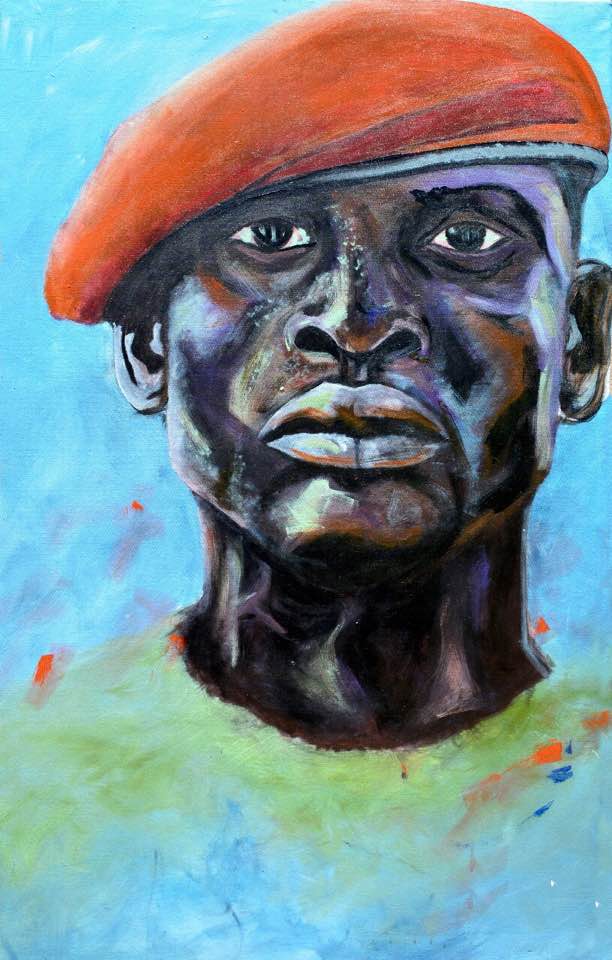
Painting of an SPLA Soldier by Abul Oyay
In commemorating May 16th — South Sudan’s SPLA Day — I often find myself reflecting on the nation’s prevailing mood at that moment. This year, my thoughts return insistently to the plight of our forgotten heroic SPLA soldiers.
It is no secret that most families in South Sudan lost scores of relatives and community members to the liberation struggle. To each family, these soldiers are not mere statistics. They are pride and promise, hopes shattered, livelihoods lost, dreams curtailed, and longed-for embraces never returned. Their eyes look upon us from beyond — hauntingly or endearingly. Their spirits linger in the lives of those left behind. My own family is no exception. Our people bore the burdens of liberation with quiet grace.
I have served as a civil servant for close to a decade and a half. For at least five of those years, I worked in Juba, where I had the privilege of interacting with some of our forgotten heroes. Often, they came seeking meetings with former comrades — now highly placed government officials. More often than not, the present fortunes of these officials do not surpass the magnitude of the sacrifices made by their now-dejected comrades in the struggle.
Some receive these visitors — pushed to the fringes of power — with humility and grace. Others shun them entirely. Still others offer empty praise and promises. The contrast is always unsettling.
The feats and acts of these officers, I came to learn, were legendary — stories told and retold in quieter spaces. Some of the more “fortunate” former officers found accommodation here and there, yet even they endured countless humiliations, especially those born of inadequate recognition. Too often, they are only adequately revered in death.
One encounter remains particularly vivid. I came to know of an Ethiopian soldier assigned to the SPLA who, since the fall of Mengistu, had been entirely cut off from his family. Feared persecuted by his government and presumed dead by all, he had lived for decades in a state of quiet statelessness. Years later, he learned of his mother’s failing health and subsequent death. His only wish was to bury her — and to see his wife and children after decades of absence.
Unable to travel, he sought South Sudanese travel documents and possible naturalization. He came to our office seeking the support of a highly placed former comrade, asking him to lend weight to a process already initiated by his superiors in Bilpham. I hope — and believe — that his case was ultimately resolved, and that he reunited with his family in Ethiopia, South Sudan, or a neighboring country. A hero who made such profound sacrifices for a people and a cause not his own deserves nothing less than honor.
Another instance involved the son of a legendary SPLA Fanan, who came knocking on the doors of his father’s former comrades seeking support for his education. Most of his appeals fell on deaf ears. Perhaps his father’s comrades were overwhelmed by the sheer number of such requests. Veterans and serving soldiers often flood offices with genuine — and at times fabricated — needs. Yet this reality does not absolve us of responsibility.
What it does demand is an operationalized, coherent policy to proactively address the needs of veterans, serving members of the armed forces, and their families. Such a policy should provide access to education and skills training, capital for self-sufficiency through enterprise, and opportunities for dignified reintegration into civilian life. The children of armed forces members should have free access to education to the highest level possible. Medical care for soldiers and their families should be guaranteed.
This may sound idealistic, but it is not unrealistic. We have the means — if only we muster the political will. Some of these measures may already exist on paper, but the fact that we continue to fail our armed forces in meeting even their basic needs is deeply troubling — quite apart from their meager salaries and persistent inequities in promotion.
Many of our heroes live with untreated post-traumatic stress disorder. Others endure abject poverty. Still others exist in a state of cognitive dissonance, unable to reconcile their present realities with their former glories. Many have suffered humiliation beyond measure.
At times, I wonder whether they ever regret a single day, a limb, or a pint of blood given for this country. A part of me believes they would consider regret the highest form of treason — a betrayal of fallen comrades and of every grain of soil made sacred by ancestral remains. And so, we — the beneficiaries of their sacrifice — must dare not regret either.
As a nation forged through fierce liberation struggles, we must do better by our soldiers and their families — and by the widows and orphans of those who paid the ultimate price. We must remember their names, honor their contributions, and act in reverence of their sacrifices. Caring for them is not charity. It is a debt — a moral obligation.
It is the noblest responsibility of statehood.
For our sovereignty stands on the shoulders of past soldiers, and its continuity depends on the strength, dignity, and commitment of those who serve today and tomorrow.
Happy May 16th, beloved South Sudan.
© Apuk Ayuel Mayen. All rights reserved.
 Apuk Ayuel Mayen