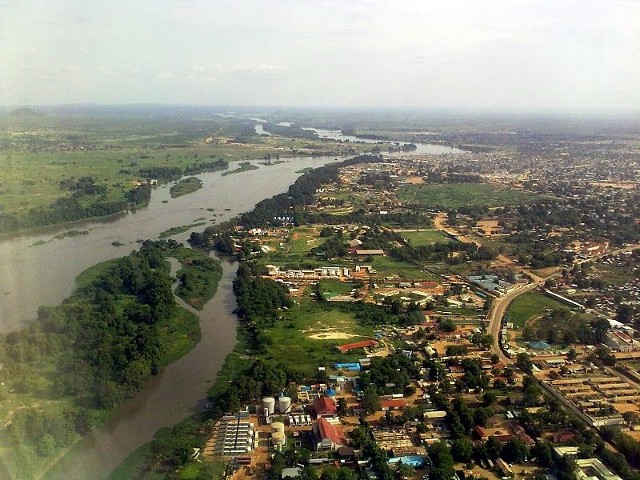
Juba is expanding exponentially. I often regard the city from above — as the plane takes off or prepares to land on my frequent flights — and I am always surprised by what has emerged in my absence. A five-story building appears where none stood before. An informal settlement sprouts overnight. A new hotel here, a bar and restaurant there. Juba is growing, and its echoes are deepening.
For the most part, this growth does not interfere with my sense of direction — except once.
There is a genenna in Rajaf West I had visited with friends some years ago. When I tried to revisit it last year, I could not, for the life of me, retrace the way. I am generally good with directions and possess an almost photographic memory when I am paying attention. But this time, an informal settlement had risen squarely in the middle of the route I once knew.
The landmarks were clear in my mind: the creek I must cross, the big tree where I must turn left, the lone house with the green door where I must turn right, the three tukul with the odd road threading through them — and then the open way to the genenna. Or so I thought.
Imagine my bewilderment when I arrived and found that the map in my mind had been rendered obsolete. I was lost — utterly and completely. The only reference point that remained was the creek. In the span of just two years, what was once a sparsely populated area had become an intricate web of informal settlements and markets. Congested is the polite word. Lost was the truer one — reverberating loudly in my psyche.
Later, on a different day, I found myself stuck in the usual traffic jam between Customs and Bilpham, caused by the congestion at the roundabout. With my windows down, listening to the radio, I watched a company of four standing by the roadside.
There was a young woman in a deep blue and black lawa, wearing a black tenora, her head shaven. An older man, nearly lame on one side — perhaps from a stroke or accident — dressed in a kaunda suit, who appeared to be the group’s anchor. A young man in a short black jalabia, clearly serving as the older man’s eyes. And a quieter, middle-aged man in grey trousers and a white shirt, who seemed uncertain of their destination altogether.
They kept looking backward, then forward — searching for a landmark that eluded them. Fingers pointed north, then south. They huddled briefly, attempting consensus, trying to summon memory. Then they scanned the road again, unsuccessfully. Finally, they headed southward, reluctantly, at the cue of the older man.
I imagined they were looking for a big tree, an abandoned vehicle, a tukul with a peculiar marking. Depending on how long it had been since their guide last walked these streets, the marker may no longer exist. Or perhaps the familiar route had been closed, forcing them onto a newer, unfamiliar path. Either way, they were lost.
With the high rates of illiteracy in our country — especially among rural communities and elderly urban residents — and the steady influx of villagers into the city, considering a villager’s understanding of landmarks is not a courtesy. It is a necessity.
This is not to overstate the difference between rural and urban dwellers, but rather to acknowledge the lowest common denominator in how most of our people navigate space. In the absence of street signs and consistent road names, direction in Juba remains deeply organic. Instructions sound like this: “Drive on Shari Kizito, look for the unfinished amara on your left, turn there, and the house is the one with the bright green zinki.”
I do not discount the progress made by the Juba City Council — traffic lights, street naming, navigational signage on major roads. These are important steps. Yet most of these developments cater to a small, English-literate segment of the population, overlooking those literate in Arabic and national languages — and entirely excluding the illiterate.
For our cousins, uncles, aunts, and grandparents walking into Juba from surrounding villages, it is crucial that development leaves behind — or deliberately creates — permanent, recognizable markers. Most of them come to sell goods at the market or to visit relatives they have not seen in years. And too often, you find them standing at the roadside, bewildered.
They do not carry phones to call for directions. Their only hope is to remember another familiar house, to chance upon a child willing to guide them, or — rarely — to stumble upon a relative. Development, if it erases memory without offering replacement, disorients more than it advances.
A city must grow. But it must also remain legible to those who arrive on foot, carrying memory rather than maps.
© Apuk Ayuel Mayen. All rights reserved.
 Apuk Ayuel Mayen